Technology
The technology behind POROUS
Research at Charité – Universitätsmedizin Berlin turned ultrasound into a tool for measuring the microstructure of cortical bone. Here you find the method, the clinical studies and the publications behind it.
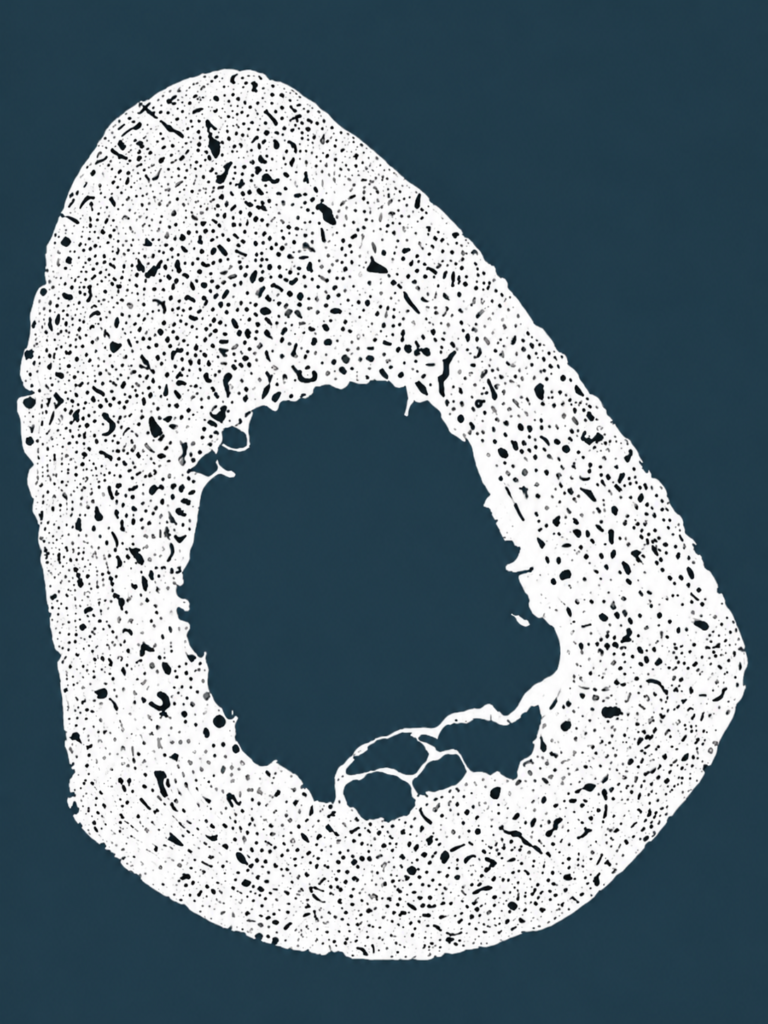
Why we look at cortical bone
Most bone loss in osteoporosis happens in the cortical bone of the peripheral skeleton: the cortex becomes thinner and its pores grow larger. Bone density measurements capture these structural changes only poorly.
POROUS measures the cortex directly at the tibia, where it lies just under the skin and can be reached with ultrasound.
Cortical thinning
A thinner cortex weakens the bone long before a fracture occurs.
Larger pores
Enlarged cortical pores are a hallmark of bone loss with age and osteoporosis.
Linked to hip strength
Large pores in the tibia were strongly associated with the strength of the femur in an ex vivo study (Iori et al., PLoS One 2019).
How POROUS reads pore size
The spectrum of the backscattered signal changes with the size of the pores. Switch between healthy and osteoporotic bone to see the effect.
- Send. A broadband pulse of several MHz enters the cortex at the tibia.
- Scatter. Every pore returns a small echo. Larger pores scatter more strongly, mainly at lower frequencies.
- Analyse. A scattering model fitted to the measured spectrum yields the pore-size distribution and the frequency-dependent attenuation.
Schematic illustration. Pores enlarged, spectra simplified.
Pore-related parameters are model-derived biomarkers of cortical microstructure, not direct images of individual pores.
Clinical studies
Measurements from around 2,000 participants so far, from first pilot studies to a 1,600-participant multicentre study.
Published
Pilot study in postmenopausal women
Women with and without fragility fractures (n = 55). The cortical biomarkers discriminated fractures better than DXA and as well as high-resolution CT (HR-pQCT).
Charité – Universitätsmedizin Berlin, 2019–2020 · Armbrecht et al., JBMR Plus 2021
Published
Bone quality in diabetes
Patients with type 1 and type 2 diabetes and age-matched controls (n = 156). Fracture discrimination of the ultrasound biomarkers (AUC 0.68 to 0.69) was better than DXA (AUC 0.61 to 0.63), and the method was not affected by the known overestimation of bone density in diabetes.
Charité, Department of Rheumatology and Clinical Immunology, 2022–2023 · DRKS00029331 · Dehnen et al., Frontiers in Endocrinology 2024
Recruitment completed
Fracture-risk prediction study (preFx)
Prospective multicentre study with 1,600 men and women aged 56 to 85 at 6 centres in 3 countries. It evaluates how well POROUS biomarkers discriminate and predict fragility fractures; follow-up continues until 2029.
Sponsor: POROUS GmbH, supported by the EIC Accelerator · NCT06567054
Completed 2026
Bone density and reference-value study
350 healthy participants aged 21 to 55 at 2 centres. The data provide reference values from young, healthy adults and an ultrasound-based estimate of bone mineral density.
Sponsor: POROUS GmbH · NCT07187518
COMPLETED
European Space Agency bed-rest study
Head-down bed rest simulates the bone loss of weightlessness. In this study ultrasound parameters changed by around 25 %, DXA by only 1–2 %, and changes were visible within 30 days.
Charité – Universitätsmedizin Berlin with the European Space Agency
Ongoing
PigBoneS: stronger bones in livestock
With SUISAG and FBN Dummerstorf we explore better phosphorus utilisation and bone stability in pigs. More than 1,500 pig bones have been measured and analysed so far.
Eureka Eurostars project, funded by BMBF and Innosuisse
From method to product
PoroScan Academic makes the POROUS method available for your own research and clinical trials. Pre-orders are open; deliveries start in December 2026, after CE marking.
Publications
Peer-reviewed work on the POROUS method, newest first.
Carolin Dehnen, Angela Galindo, Paula Hoff, Oliver Palme, Lukas Maurer, Kay Raum and Edgar Wiebe (2024)
Nguyen Minh, Marie Muller, Kay Raum, K. (2022 )
Armbrecht, G., Nguyen Minh, H., Massmann, J., & Raum, K. (2021)
Iori, G., Du, J., Hackenbeck, J., Kilappa, V., & Raum, K. (2021)
Nguyen Minh, H., Du, J., & Raum, K. (2020)
Gianluca Iori, Johannes Schneider, Andreas Reisinger, Frans Heyer, Laura Peralta, Caroline Wyers, Melanie Gräsel, Reinhard Barkmann, Claus C Glüer, J P van den Bergh, Dieter Pahr, Kay Raum (2019)
Scientific Advisory Board
Leading experts in osteology guide our research strategy and study design. They bring scientific and clinical experience from institutions across Europe.
Frankfurter Hormon- und Osteoporosezentrum
Frankfurt, Germany
Christian-Albrechts-Universität zu Kiel
Kiel, Germany
Maastricht University and VieCuri Medical Centre
The Netherlands
Friedrich-Alexander-Universität Erlangen-Nürnberg
Erlangen, Germany
Use the POROUS method in your research
Planning a study on bone quality, an intervention or a new patient group? We support you with study design, devices, training and data analysis, and with your grant application.